Morningstar's REIT Outlook

This Morningstar video does a great job of summarizing the current investment environment for REIT stocks. It was produced on October 28, 2008, but it will be relevant (and worth watching) well into 2010. The video concisely reviews the salient risks around all REIT property groups: landlords are facing weaker occupancies and lower rent growth due to the weakening economy, at the same time that supply in some markets (particularly hotel and retail) will be increasing. In addition, many REITs are also carrying unsustainable debt levels associated with higher LTV lending at a time when property values were inflated, all of which will be difficult to refinance. This will undoubtedly impact REIT Dividends.


One aspect of the equation that is missing from this dour analysis is the effect of dramatically lower oil prices. Gas prices, even here in California, are now flirting with $2.00 a gallon from just over $5.00 only six months ago. Economists believe that the effect of this drop in fuel prices is double or triple the amount of the $150 billion 2008 economic stimulus package, and it accounts for about 4% (and counting) of disposable income that is no longer being "disposed" of in the tank. Presumably, these economists also hope that consumers will spend this extra cash on baubles and trinkets, rather than stuff it under their mattresses as I have done.


See the REIT Definition post for more information on REIT Wrecks's raison d'etre. Scroll down for more REIT and real estate related news, resources and links.

Click here for a list of Apartment REITs
Click here for a list of Healthcare REITs
Click here for a list of Hotel REITs
Click here for a list of Industrial REITs
Click here for a list of Mortgage REITs
Click here for a list of Office REITs
Click here for a list of Retail REITs
Click here for a list of Storage REITs

Mortgage REITs

Disclosures: None at the time of publication
, , , ,

Labels: ,

More Downside in Equity REITs?

I think that depends on what type of Equity REIT you're talking about. There really isn't anything too new in this video, but in the process of highlighting continued broad downside risk in Equity REITs (recession=lower rents, lower occupancy & ultimately reduced dividends), there is also an interesting contradiction. If it will be "pretty hard to pay down....debt on assumptions" that rents and occupancy will increase, why is the "far better option" to buy AAA CMBS yielding 14% still not considered too risky?


Some Equity REITs may indeed suffer downside if the recession deepens, particularly those in more sensitive sectors such as retail and hospitality, but the fact that AAA CMBS is now considered the "far better option" suggests that some Mortgage REIT portfolios may soon bottom. Meanwhile, a very good buy-side analyst I know is buying all the Equity REITs he can get his hands on - in the apartment sector. More on that tantalizing topic to follow!


See also REIT Definition. Scroll down for more REIT and real estate related news, resources and links.

Click here for a list of Apartment REITs
Click here for a list of Hotel REITs
Click here for a list of Industrial REITs
Click here for a list of Mortgage REITs
Click here for a list of Office REITs
Click here for a list of Retail REITs

REIT dividends

Labels: , , ,

TARP Torpor Torpedoes REITs

No wonder the original plan what plan? was only three pages long. It turns out that there was no plan. When I heard the news that Treasury had reversed course on the Troubled Asset Recovery component of the Troubled Asset Recovery Plan, that and writing an article with the above title were the first things that popped into my head. Sadly, those two things were also all I could think of while I was cowering under my desk, without food and water, waiting for it all to end. REITs of course got absolutely crushed, and now it looks like many REITs are now headed for the dreaded ".BB" designation. I keep hoping in vain to someday drown in dividends, but that's unlikely to happen if REITs are swimming in the Pink (sheets that is).

The story of the insanity in commercial mortgages that ensued after the about face now been covered everywhere, including the Wall Street Journal, the Washington Post, and Bloomberg, which was the most strident in blaming it all on Paulson. Sadly, spreading blame won't help; only spreading money will (and maybe some Prozac too, if I could only afford to see the doctor).

What follows is a relatively cogent article consisting of the most juicy bits from those three above articles.

"A lot of very foolish loans were originated between 2005 and 2007, and many of those loans begin to mature in 2010," said Mike Kirby, director of research at Green Street Advisors, a commercial real estate research firm. "You have a significant amount of debt maturing at that time and yet you don't have a market to replace that debt."

The price of commercial real-estate-debt securities has fallen so far that it has set off a debate among investors as to whether now is the time to get back into the market. Triple-A commercial mortgage-backed securities are trading at roughly 70 cents on the dollar, meaning they would produce a 20% return if held to term.

The default rate on commercial mortgages remains near its historical low, although it is increasing. Overall, the number of commercial mortgages packaged into securities that are 30 days or more past due rose to 0.64% in October from 0.39% at the end of last year. That is the highest delinquency rate in two years but still far from the kind of carnage that occurred during the commercial real-estate collapse of the early 1990s. Back then the cumulative default rate on loans made in 1986 reached 36%.

The trading levels of CMBS bonds imply a cumulative loss rate of as much as 40% on top-rated bonds, which means that at least 70% of the underlying loan pool would have to go into default, [emphasis added] said Richard Parkus, head of CMBS research at Deutsche Bank Securities Inc. But he, like other market observers, views that as an unlikely scenario. ...

The spreads between the CMBX, a credit market index that tracks the values of commercial real-estate bonds, widened to another record level Thursday. And CMBS bonds with triple-A ratings now yield more than 14 percentage points above yields on 10-year U.S. Treasury notes, according to Trepp, a New York company that tracks the commercial real-estate-finance market. That compares with a 1.5 percentage point spread one year ago and an 8.3 percentage point spread just one week ago.

At current prices, all the loans could default within 18 months and a buyer wouldn’t lose money, according to Lisa Pendergast, an analyst at the Greenwich, Connecticut-based unit of Royal Bank of Scotland Plc. That’s assuming foreclosure recoveries of 37 percent, compared with the typical 60 percent.

“The default levels implied by where these bonds are trading mean we will all be living in boxes,” said Eric Johnson, president of 40/86 Advisors Inc. in Carmel, Indiana.

“There is evidence that short-sellers are targeting this market because they know they can push it around,” said James Grady, managing director in New York at Deutsche Asset Management, which has about $240 billion of fixed-income assets under management.

“Recent speculative conditions reminds us of the summer when oil was $140 a barrel, and many parties were calling for $200,” Darrell Wheeler, of Citigroup wrote. “Commercial real estate conditions are deteriorating, but we cannot justify recently cheap levels.”

Let's hope so. I have bills to pay.


REIT Stock Dividends

Labels: ,

Big CMBS Loans Near Default; CMBX Soars, REITs Tank

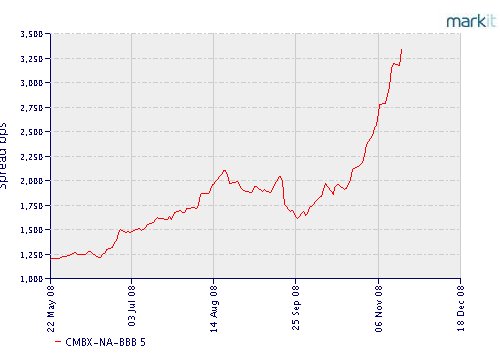
The BBB-5 CMBX is above 3250, do you know where your money is? These are record levels for the index, and they are seemingly indicative of even greater trouble in the CMBS market. If one were to use the stock price of many Mortgage REITs however, it would seem that the soaring Markit index is actually behind the times for a change:

CMBX & REITs

Part of the reason for the distress in the index and also the basement-dwelling stock prices of many Mortgage REITs is that two very large loans that were securitized into CMBS, including one loan secured by two Westin hotels, appear to be nearing imminent default. Of course, this distress is also due to the forced selling of anything that hasn't already been seized by the county sheriff.

The $209 million Westin loan is backed by two hotels located in Tucson, Arizona, and Hilton Head, South Carolina. The slowing economy has hurt hotel operators as consumers and businesses have cut back on travel. The second loan nearing default is a $125 million loan for The Promenade Shops at Dos Lagos, which is located in Corona, California. Southern California has been dealt a particularly heavy blow by the worst housing crisis since the Great Depression.

Credit Suisse analysts reported that the Weston loan is split between two JPMorgan-issued CMBS deals. J.P. Morgan Chase Commercial Mortgage Securities Trust 2008-C2, the more recent of the two deals, is heavily exposed. That trust's portion of the defaulting Westin loan represents 8.9% of the total collateral pool. Unfortunately, the bad loan on the Promenade Shops is also the largest loan in the same pool, representing fully 10.7% of the collateral. This means two of the top-ten largest loans in the pool, representing almost 20% of the collateral, are about to default. Investors in all but the most senior tranches of this issue are now facing huge losses as remaining cash flows are diverted to those who occupy higher ground (see the post "What is Securitization" for more detail on how subordination impacts Mortgage REITs).

It is not surprising that hotel and retail loans would come under pressure, particularly a retail loan made in Southern California, which was practically the belly of the beast. Hotel occupancies and retail sales have been especially hard hit as consumers and businesses snapped wallets shut when the credit crisis started making what Ross Perot could only have described as that "giant sucking sound".

The real interesting aspect of these latest defaults is that everyone involved should have known better. Yet the pressure to produce, rate and sell still seems to have trumped the mirrors in front of our faces.

All of the mortgage loans in the pool were originated between June 27, 2007 and April 30, 2008, and the securitization closed on May 8, 2008, well after the Bear Stearns collapse and Ralph Cioffi scapegoat perp walk was led away in handcuffs.

Nevertheless, the Westin loans were interest-only for 36 months and had underwritten debt service ratios (DSCR) at closing of less than 1.25%. This would have been considered risky even in 2006. The loan agreements on the Promenade Shops were interest-only for 60 months and had underwritten DSCR of just 1.10%. The Promenade loan also allowed additional subordinated debt provided that the combined LTV did not exceed 85% and the combined DSCR did not fall below 1.00%. This is the equivalent of allowing someone to rent an apartment that will consume 100% of their monthly take-home pay (assuming a landlord would let anyone do such a thing). More than 75% of the loans in the pool were interest-only or partial-interest only. Other large loans in the pool include the Las Vegas headquarters of Station Casinos good luck and several other large retail and hospitality properties.

One would have thought, given the media and political spotlights around shoddy underwriting and hopelessly conflicted ratings agencies, that underwriting standards would have improved and that CMBS investors would be taking a much harder look at the bonds being furiously shoveled in their direction.

So is it really any wonder that Mortgage REIT stocks are in the tank when two of the top-ten largest loans in a May 2008 CMBS deal, representing almost 20% of the collateral, have gone up in smoke in just six short months?

Click here for an updated Mortgage REIT list, including current yields.

REIT dividends
Disclosure: None at the time of this writing

Labels: , , , , ,

Capital Source Abandons REIT status

For the sake of good order, I need to post the fact that Capital Source has decided to revoke its REIT status after writing about CSE's chameleon-like transformation into a bank, among other things, in the postMortgage REITs & Custer's Last Stand. Morphing into a bank allows CSE to take advantage of inexpensive, stable deposits as a funding source, but with the revocation of REIT status as of 2009, CSE is no longer required to meet the IRS requirements with respect to distribution of its income to shareholders (see REIT Definition) . Accordingly, an investment in CSE is now simply an investment in a regional bank, not a REIT.

The Chevy Chase-based company, which earlier this year bought 22 bank branches from Fremont General Corp., will keep its REIT status for the rest of 2008, but will not be a REIT in 2009.

CapitalSource said in a statement that while REIT status has tax advantages, it is "imprudent and perhaps impossible" to maintain a large portfolio of residential investment assets in 2009 due to the uncertain credit markets and weak economic environment.

The company plans to sell its residential mortgage-related investments early next year.

"Entering 2009, CapitalSource will look similar to the way it did prior to becoming a REIT in 2006 with three important exceptions: the company will have achieved its strategy of becoming a bank, leverage will be lower and it will be the owner of a healthcare net lease business," said chairman and chief executive John K. Delaney in a statement.

CapitalSource said it will keep paying dividends in the fourth quarter and in 2009.

CapitalSource Inc. has suffered amid a weakening economic environment in recent months. The company in August reported a 29 percent profit decline Tuesday as its commercial loan portfolio shrunk.

In September it slashed its quarterly cash dividend by 92 percent.

Earlier this month the company said it would delay an initial public offering for a minority interest in its health care real estate investment trust, CapitalSource Healthcare REIT, because of the volatile market.

However, this IPO could still occur at some point, the company said.

"The decision to revoke our REIT election for 2009 does not preclude any transaction in 2009 with respect to our healthcare net lease business, including an IPO of the business as a separate publicly traded healthcare REIT," said Thomas A. Fink, CapitalSource CFO, in a statement.

The fact that Capital Source, a relatively healthy REIT, has decided to revoke its REIT status is significant. The REIT model is still broken, and investors continue to punish companies that invest in real estate-related assets, particularly mortgages. Capital Source is gambling that abandoning its connection to the beleaguered business model will cause investors to value the business in a way that is more closely aligned to instrinsic value. REIT investors should remember, however, that CSE's business has not changed. Capital Source has done nothing but abandon a stigma that unduly punished its valuation.

Click here for an updated Mortgage REIT list, including current yields

REIT list

Disclosures: None at the time of publication
, , , ,

Labels: