
Tuesday, November 18, 2008

Big CMBS Loans Near Default; CMBX Soars, REITs Tank


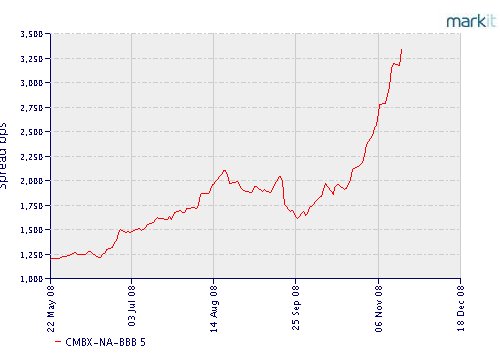
The BBB-5 CMBX is above 3250, do you know where your money is? These are record levels for the index, and they are seemingly indicative of even greater trouble in the CMBS market. If one were to use the stock price of many Mortgage REITs however, it would seem that the soaring Markit index is actually behind the times for a change:

CMBX & REITs

Part of the reason for the distress in the index and also the basement-dwelling stock prices of many Mortgage REITs is that two very large loans that were securitized into CMBS, including one loan secured by two Westin hotels, appear to be nearing imminent default. Of course, this distress is also due to the forced selling of anything that hasn't already been seized by the county sheriff.

The $209 million Westin loan is backed by two hotels located in Tucson, Arizona, and Hilton Head, South Carolina. The slowing economy has hurt hotel operators as consumers and businesses have cut back on travel. The second loan nearing default is a $125 million loan for The Promenade Shops at Dos Lagos, which is located in Corona, California. Southern California has been dealt a particularly heavy blow by the worst housing crisis since the Great Depression.

Credit Suisse analysts reported that the Weston loan is split between two JPMorgan-issued CMBS deals. J.P. Morgan Chase Commercial Mortgage Securities Trust 2008-C2, the more recent of the two deals, is heavily exposed. That trust's portion of the defaulting Westin loan represents 8.9% of the total collateral pool. Unfortunately, the bad loan on the Promenade Shops is also the largest loan in the same pool, representing fully 10.7% of the collateral. This means two of the top-ten largest loans in the pool, representing almost 20% of the collateral, are about to default. Investors in all but the most senior tranches of this issue are now facing huge losses as remaining cash flows are diverted to those who occupy higher ground (see the post "What is Securitization" for more detail on how subordination impacts Mortgage REITs).

It is not surprising that hotel and retail loans would come under pressure, particularly a retail loan made in Southern California, which was practically the belly of the beast. Hotel occupancies and retail sales have been especially hard hit as consumers and businesses snapped wallets shut when the credit crisis started making what Ross Perot could only have described as that "giant sucking sound".

The real interesting aspect of these latest defaults is that everyone involved should have known better. Yet the pressure to produce, rate and sell still seems to have trumped the mirrors in front of our faces.

All of the mortgage loans in the pool were originated between June 27, 2007 and April 30, 2008, and the securitization closed on May 8, 2008, well after the Bear Stearns collapse and Ralph Cioffi scapegoat perp walk was led away in handcuffs.

Nevertheless, the Westin loans were interest-only for 36 months and had underwritten debt service ratios (DSCR) at closing of less than 1.25%. This would have been considered risky even in 2006. The loan agreements on the Promenade Shops were interest-only for 60 months and had underwritten DSCR of just 1.10%. The Promenade loan also allowed additional subordinated debt provided that the combined LTV did not exceed 85% and the combined DSCR did not fall below 1.00%. This is the equivalent of allowing someone to rent an apartment that will consume 100% of their monthly take-home pay (assuming a landlord would let anyone do such a thing). More than 75% of the loans in the pool were interest-only or partial-interest only. Other large loans in the pool include the Las Vegas headquarters of Station Casinos good luck and several other large retail and hospitality properties.

One would have thought, given the media and political spotlights around shoddy underwriting and hopelessly conflicted ratings agencies, that underwriting standards would have improved and that CMBS investors would be taking a much harder look at the bonds being furiously shoveled in their direction.

So is it really any wonder that Mortgage REIT stocks are in the tank when two of the top-ten largest loans in a May 2008 CMBS deal, representing almost 20% of the collateral, have gone up in smoke in just six short months?

Click here for an updated Mortgage REIT list, including current yields.

REIT dividends
Disclosure: None at the time of this writing

Labels: , , , , ,

7 Comments:

Anonymous Dear John Thain said...

Hi,

First, I find nearly no evidence for your linkage between REIT stocks and two (technically three) loans in CMBS deals. I also don't even know how exposed CMBX Series 5 is to these loans since the deal you mention, JPMCC 08-C2, isn't in series 5.

Second, you misunderstand DSCR since you erroneously cite it as a percentage when it is a multiple (the DSCR is 1.25x, not 1.25%).

Third, you don't seem to understand the CMBS market when it comes to underwriting since over a 1.20x DSCR is considered standard and very safe.

Lastly, it is entire meaningless to cite IO percentages of a CMBS pool. I'm not sure you know this, but loans backing CMBS deals, unlike similar residential deals, are generally 10/30's ... This means that they are 10 year loans that follow a 30 year amortization schedule and require a balloon payment (payment in full) after 10 years (unusual because the loan isn't fully amortizing).

Please check your facts before drawing conclusions. Sorry..

-DJT

November 19, 2008 6:16 AM  
Anonymous Dear John Thain said...

My mistake, JPMCC 08-C2 *is* in Series 5. The source I went to wasn't authoritative and that's my error. It is, however, not necessary for my first point.

-DJT

November 19, 2008 6:33 AM  
Blogger RW said...

Sorry John, but I own commercial real estate, I manage commercial real estate, I have borrowed against it, and I have underwritten commercial real estate debt and equity for sale into the secondary markets. So I can confidently tell you that a 36 month I/O with a 1.20 debt coverage ratio, whether you append it with a % sign or a little x, is still cosidered low. Most lenders publicly say they won't go below 1.25, but if you do a deal with them, they'll find all kinds of reasons not to get anywhere close to 1.25.

Clearly, that 1.20 was also not a real 1.20 or the loan would still be in good shape, and 1.00 is just crazy.

Furthemore, as for the 10/30s, I prefer them. It is how I borrow, and they are considered much safer from both the borrower's and lender's perspective. Consequently, most loans in pre-2005 CMBS deals were 10/30s. However, as the credit bubble fire turned into an inferno, fueled by by deteriorating underwriting standards, the number of CMBS I/O loans increased dramatically.

There is definitely a role for I/O loans. When there is a strong case for a large and dependable increase in NOI, they are perfect. However, the loans in question were for stabilized properties with relatively stable income streams (or so the underwriters hoped). 1.20 debt coverage on an I/O loan, which is lighter on the wallet than a 10/30 (which includes principle repayments as well as interest payments) is not the same and is indicative of a borrower pushing the limits on leverage.

The entire world is lining money up against the record number of 3 and 5 year I/O CMBS loans that will start coming due in 2009 and not be able to refinance. That 75% of a brand new 2008 CMBS deal would be comprised of such loans (they are the ALT-As of the commercial world) is just crazy...and these defaults pretty clearly tell that story .

As far as the technical connection between REIT stocks and these three CMBS deals, it is this: if in 2008 we are seeing defaults in three of the top-ten largest loans in a CMBS deal barely six months old, how many shoes are there left to drop in 2009 when it's time to refinance all those I/O loans that are performing but just barely hanging on?

I'm not saying there is no upside in REITs. I actually believe there could be huge upside, but it's a matter of price. And these defaulted loans have cast that price into uncertainty yet again.

Good luck and thanks for reading. I appreciate your comments; they are an opportunity to clarify my thoughts and bring more transparency to this murky world!

Cheers.

November 19, 2008 8:40 AM  
Anonymous Anonymous said...

small but important difference:

a partial term I/O loan that is underwriten to 1.20, does not cover at 1.20 during the I/O period. the 1.20 is post I/O period.
a dscr of 1.20 on a full term I/O is underwriten to 1.20.

November 19, 2008 4:48 PM  
Anonymous Anonymous said...

I’m astonished by private investors ignorance of what is going on in the debt markets. We’ve got a couple hundred thousand square feet of class B warehouse space in the Denver area and are card carrying member’s of the club “lining money up against the record number of 3 and 5 year I/O CMBS loans that will start coming due in 2009 and not be able to refinance.” The reasonableness coming from the ask side is almost offensive. I’m assuming it’s a function of entry price points, and participants stubbornness that they’d have to ‘bring money to the table’ to get the deal done (that is, if they’ve got said money). This is an area that has been overlooked, which is understandable. But there has been the same degradation in commercial real estate involving small businesses and small private investors ($500k to $5mil) as there was on the residential side. True, the supply problem is probably not as severe, but the financing is the same in all but name.
RJ

November 19, 2008 6:55 PM  
Anonymous Anonymous said...

there was a record number of 3 and 5 year I/O loans? huh?

very very very few fixed rate 3 year CMBS loans were made, and only a few 5 and 7 year loans. I am guessing you are refering to the partial term I/O loans, they dont need to refi when they begin to amortize. They just need to be able to make the interest and principal payment. And as mentioned above, they were not underwriten on their I/O payment, but to the payment after the I/O period has ended.

it will depend on property cash flows which as we are seeing are getting hammered. but lower cash flow would have effected them with or without an I/O period. actually, a partial term I/O loan underwritten to a 1.20, is closer to a 1.40 actual dscr during the I/O period, so maybe better to weather a few years downturn and give them time to fill vacated space.
Probably the only relavance the partial term I/O period has is on amount of amortization as of the balloon date. On a fully amortizing loan, the balance is paid down around 15% at year 10.

BTW, in terms of actual CMBS loan maturities, where they do need to refi, 2009 and 2010 will be relatively quiet years

i am not here to say losses wont be large on these deals, as they likely are. but it wont be because of partial term I/O loans. you can easily check the performance of partial term I/O loans, look at 2005 vintage loans, many of those were partial I/O that began to amortize this year.

November 19, 2008 10:58 PM  
Blogger Yura said...

Three years ago I sold my first home without any Net resources. But it was very difficult for me. I heard that some services can publish ads about my home in the Internet. Can you help me to choose between Fizber and Trulia? Do you know anything about these services? My friend said that "Fizber" better than "Trulia". But maybe he wasn't right. So I need help.

November 29, 2008 11:47 AM  

Post a Comment

Links to this post:

Create a Link

<< Home